Fixing Cursor-Generated Code: A Practical Approach
A repeatable approach for turning fast-but-fragile AI-generated code into something you can build on.
· BuildRescue Engineering
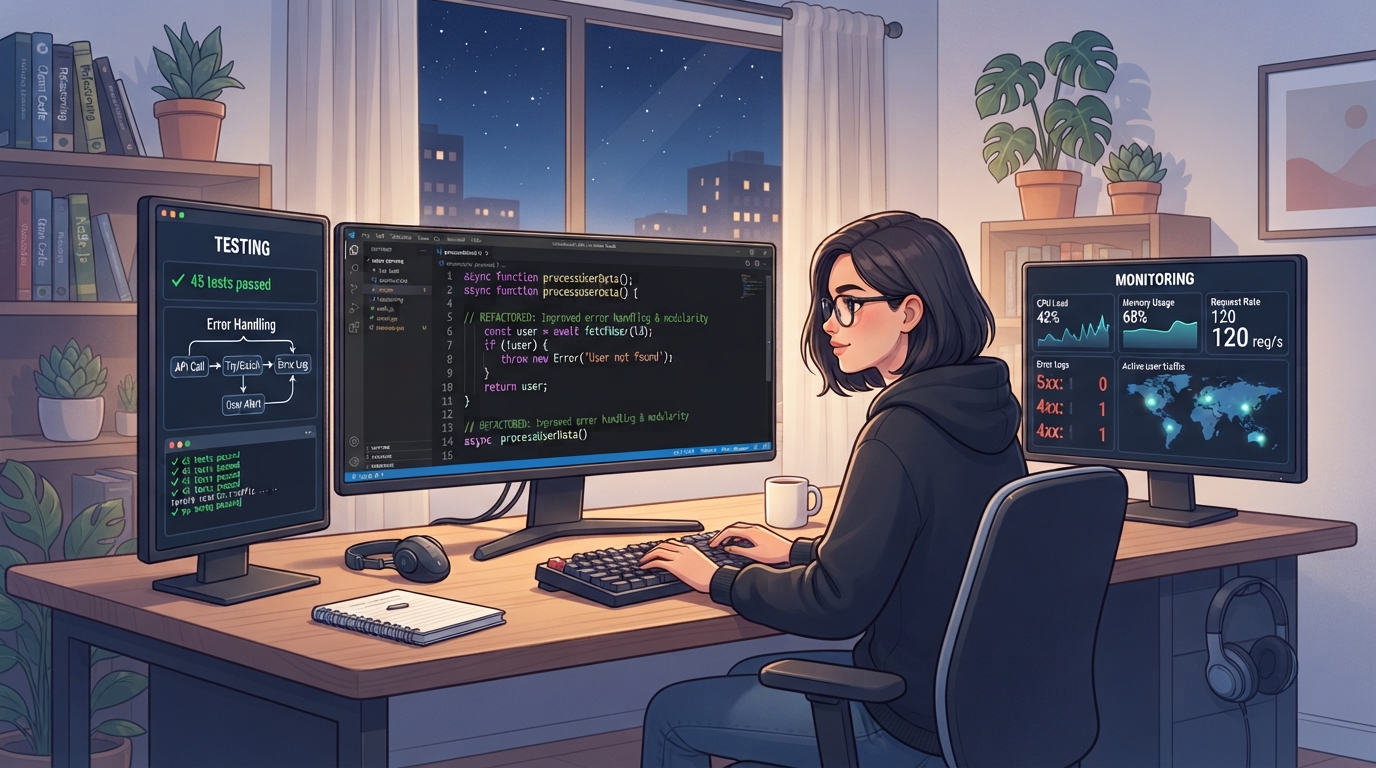
Identify Common Cursor Code Pitfalls
When working with Cursor-generated code, certain pitfalls frequently arise that require careful attention. Incomplete logic is a common issue, where the AI-generated code seems functional but misses critical conditions for handling edge cases. This can lead to unexpected behavior when put into production.
Additionally, the code might suffer from a fragile architecture, where components are overly interdependent, making any change prone to causing new bugs. By understanding these typical problems, you can approach code fixes with a clear focus on stability and robustness.
Establish a Baseline with Testing
Before diving into code changes, it's crucial to establish a solid baseline through comprehensive testing. Testing allows you to understand what currently works and what doesn't, providing a reference point for any subsequent adjustments.
Automated testing tools can be especially beneficial, enabling you to run a suite of tests quickly to identify where the code breaks or behaves unexpectedly. This process not only highlights immediate areas for improvement but also safeguards existing functionalities.
- Run unit tests to validate individual components
- Implement integration tests for combined functionalities
- Utilize end-to-end tests to simulate real user interactions
- Leverage continuous testing tools for ongoing validation
Refactor for Stability
Refactoring is key to enhancing the stability of Cursor-generated code. Start by simplifying complex logic structures, which often hide bugs and make the code difficult to maintain. Breaking down these structures into smaller, more manageable pieces can significantly improve readability and testability.
Another effective strategy is to adhere to coding conventions that promote clarity and consistency, making the code easier to understand and work with in the future.
- Simplify nested conditionals and loops
- Modularize code into reusable functions
- Enforce consistent variable naming conventions
- Remove redundant or unused code
Integrating Error Handling Mechanisms
Robust error handling is essential for preventing crashes and ensuring smooth operations in production environments. Implementing error handling mechanisms helps in capturing and addressing issues before they can escalate into significant problems. Consider employing try-catch blocks for managing exceptions and using logging to capture error details.
These practices not only stabilize your application but also provide valuable insights into recurring issues.
- Use try-catch blocks to handle exceptions gracefully
- Implement logging to track error occurrences
- Set up alerts for critical error conditions
- Regularly review error logs to identify patterns
Track Improvements with Continuous Monitoring
Once refactoring and error handling are in place, continuous monitoring is vital to sustaining improvements and quickly detecting new issues. By integrating monitoring tools, you can keep a real-time watch on the application's performance and user interactions.
This proactive approach allows for early intervention when anomalies are detected, minimizing downtime and maintaining the integrity of your AI-generated code.
Frequently asked questions
What common errors occur in Cursor-generated code?
- Common errors include incomplete logic that fails to handle all edge cases, and a fragile architecture that makes the code vulnerable to breaking when changes are made.
How can automated testing help stabilize AI-generated code?
- Automated testing helps by quickly identifying areas where the code does not function as expected, allowing for targeted fixes that ensure existing functionalities remain intact.
What are best practices for refactoring AI code?
- Best practices include simplifying complex logic, modularizing code, following consistent naming conventions, and removing redundant code to enhance readability and maintainability.
Why is error handling crucial in AI applications?
- Error handling is crucial because it prevents crashes, ensures smooth operation, and provides insights into the application's behavior, helping to maintain stability in production environments.
How often should I monitor my AI code after changes?
- Continuous monitoring should be implemented to track real-time performance and quickly catch any issues that arise, allowing for prompt interventions as needed.